

If you opened a friend's profile and saw a small badge showing a planet next to their name, you've just discovered one of Snapchat's most talked-about features. The Friend Solar System is part of Snapchat Plus and it turns your friendships into a mini universe — with you as the Sun and your eight closest friends orbiting around you as planets. Each planet has a specific meaning, and the position changes based on how much you actually interact with that person.
Most guides on this topic just list the planets in order and leave it at that. This one goes further — covering what moves your ranking, what each planet visual looks like, the differences between the Best Friends and Friends badges, and the one misconception nearly everyone gets wrong.
How the Friend Solar System Actually Works
The concept is simple. You are the Sun. Snapchat looks at the last 7 days of your activity with each friend — snaps sent, snaps received and opened, chat frequency, story reactions, and streaks — and assigns your eight most active connections as planets in order of closeness. Mercury is the friend you interact with most. Neptune is the eighth.
The ranking updates automatically and regularly. If you start snapping someone new every day, they can move from the outer planets to Mercury within a week. If you go quiet with an old friend, they drift outward. It's a live reflection of your recent activity, not a permanent label.
One thing most people get wrong: being someone's Mercury does not mean they are your Mercury. The system is one-sided. You are ranked separately in each other's solar systems based on your individual interaction patterns. You could be their top friend while they appear as your Saturn. The only way to know your position in someone else's system is to open their profile and tap their badge.
The Two Badges — Best Friends vs Friends
When you open a friend's profile you'll see one of two gold-outlined badges:
Best Friends badge: You are both in each other's top 8. You appear as a planet in their solar system and they appear as a planet in yours.
Friends badge: You are in their top 8, but they are not in yours. You still have a planet position in their system, but the badge reflects the asymmetry.
Tapping either badge reveals your planet — the animation shows a small solar system with your Bitmoji sitting on the relevant planet.
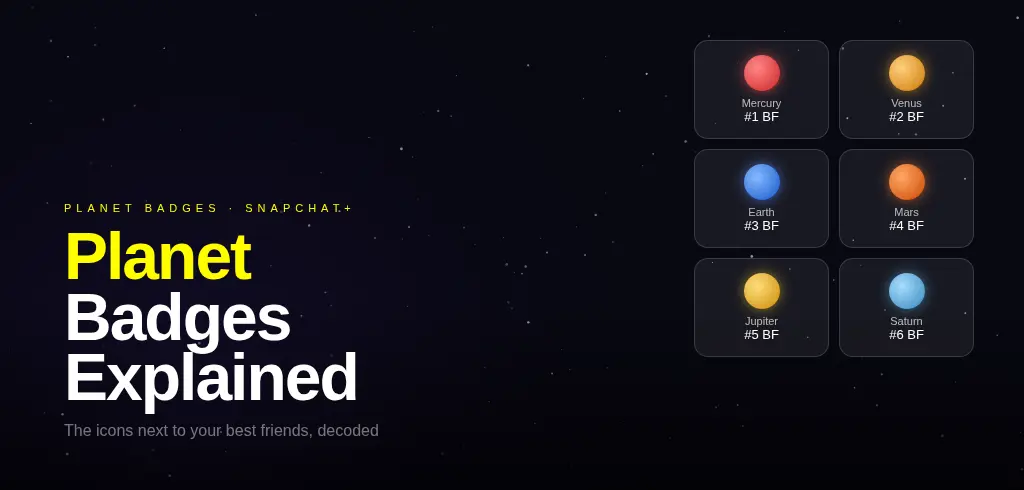
Every Planet in Order — What Each One Means
Mercury — Your #1 Best Friend
Mercury is the closest planet to the Sun, and on Snapchat it means you interact with this person more than anyone else on the platform. You're sending and receiving snaps constantly, your streaks are strong, and the connection is highly active. The planet appears as a bright red sphere with small red hearts orbiting it. If someone is your Mercury, the friendship is genuinely front and centre in your Snapchat activity.
Venus — Your #2 Best Friend
Venus represents your second most active connection. The interaction level is high — close to Mercury — but just slightly less frequent overall. Visually it appears as a pale yellow-beige planet surrounded by pink, purple, and yellow hearts. A strong friendship that just isn't quite as dominant as your number one.
Earth — Your #3 Best Friend
Your third closest friend. The Earth icon uses familiar blue and green tones with red hearts and stars around it. Someone at Earth level is still very much in your regular rotation — you're snapping them often, just not quite as relentlessly as your top two.
Mars — Your #4 Best Friend
Mars is a dark red planet surrounded by purple, blue, and star decorations. At position four, this is a solid friendship with consistent but not daily activity. You interact when there's something worth saying rather than snapping for the sake of it. A real friend who's just slightly lower in the frequency count.
Jupiter — Your #5 Best Friend
The largest planet in our solar system appears as a large reddish-orange planet with orange stripes and stars. A Jupiter-ranked friend is comfortable and familiar — you're still in each other's orbit regularly, but the day-to-day snapping is more relaxed. Think of it as a friendship you maintain rather than one you actively build every day.
Saturn — Your #6 Best Friend
Saturn comes with its distinctive ring and appears as an orange planet with stars. Position six means the interactions have become noticeably less frequent. You still snap this person, but it may be more reactive — responding to their stories, the odd check-in — rather than initiating daily conversations.
Uranus — Your #7 Best Friend
Uranus appears as a calm green planet, notably with fewer hearts and decorations than the closer planets. The lack of hearts in the visual is intentional — it signals a more distant connection. You're still in their top 8, which means something, but the communication is fairly sparse and irregular.
Neptune — Your #8 Best Friend
The farthest planet. Neptune appears as a deep blue planet, and it's the only one where your friend's Bitmoji doesn't face toward the Sun — a subtle design choice by Snapchat that reflects the emotional distance. Being someone's Neptune doesn't mean the friendship is bad, just that among their top 8 active contacts you are the least frequent communicator. If you want to move closer, start snapping more consistently.
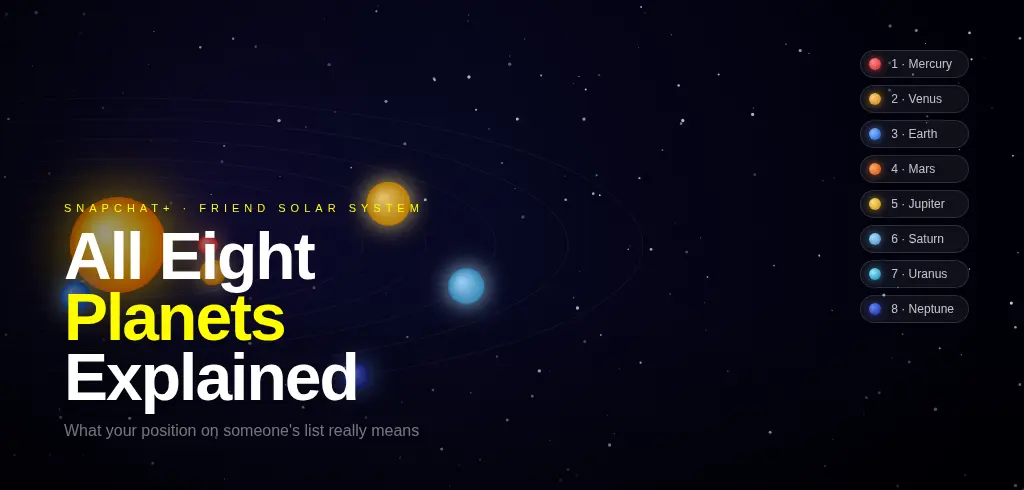
What Actually Moves Your Planet Ranking
Snapchat doesn't publish the exact formula, but based on how the system behaves in practice, these factors carry the most weight:
Snap frequency — How many snaps you exchange with this person. More exchanges means a closer orbit.
Streaks — Active snap streaks contribute to ranking. Maintaining a long streak with someone signals consistent daily engagement.
Chat messages — Regular chat activity adds to your ranking with a friend, though snaps carry more weight than text messages.
Story reactions — Reacting to someone's story or them reacting to yours signals engagement and counts toward the calculation.
Recency matters — The system weights recent activity heavily. An old friend you haven't snapped in a month will drift outward even if you were once each other's Mercury. The ranking is about now, not history.
How to Enable the Friend Solar System
The feature is off by default for new Snapchat+ subscribers. To turn it on: open your Snapchat profile, scroll to the Snapchat+ section, find Friend Solar System, and toggle it on. Once enabled, you'll be able to tap any friend's badge to see your planet in their system.
If you're not seeing the option, check that your app is updated to the latest version — older builds don't always show it. And of course you need an active Snapchat+ subscription, as this feature is not available on the free version of the app.
What Your Planet Position Actually Tells You
The solar system is a snapshot of activity, not a verdict on how much someone values you. Someone can be your Mercury because you both send silly photos every morning — that doesn't necessarily mean it's your deepest friendship. Equally, a close friend who isn't on Snapchat much might sit at Neptune despite meaning a lot to you in real life.
Where it does get interesting is when you notice a friend has drifted from Mercury to Saturn over a few weeks. It can be a useful signal that the day-to-day communication has dropped off, even if nothing dramatic has happened. Some people use it as a lighthearted way to keep tabs on who they're staying close to and who they've gradually lost touch with.
If you want to move up in a friend's ranking, the answer is straightforward — snap them more, keep your streak alive, react to their stories, and keep the conversation going through snaps rather than chat. Consistent daily activity is what pushes you toward Mercury, and going quiet is what sends you toward Neptune.
If growing your overall Snapchat presence matters to you, it's also worth knowing that a higher Snapchat score makes your profile look more established and active. You can read more about how to increase your Snapchat score fast or jump straight to a 100K boost if you want results without the wait.
A higher Snapchat score makes your profile look more established. Read: how to increase your Snapchat score fast in 2026 or go straight to a 100K boost. Also: Snapchat Plus — all features and is it worth it in 2026.